

Share to
Double-Convex Lenses
Still deciding? Get samples first, Contact US !
View similar products
Tag list
- Detailed
-
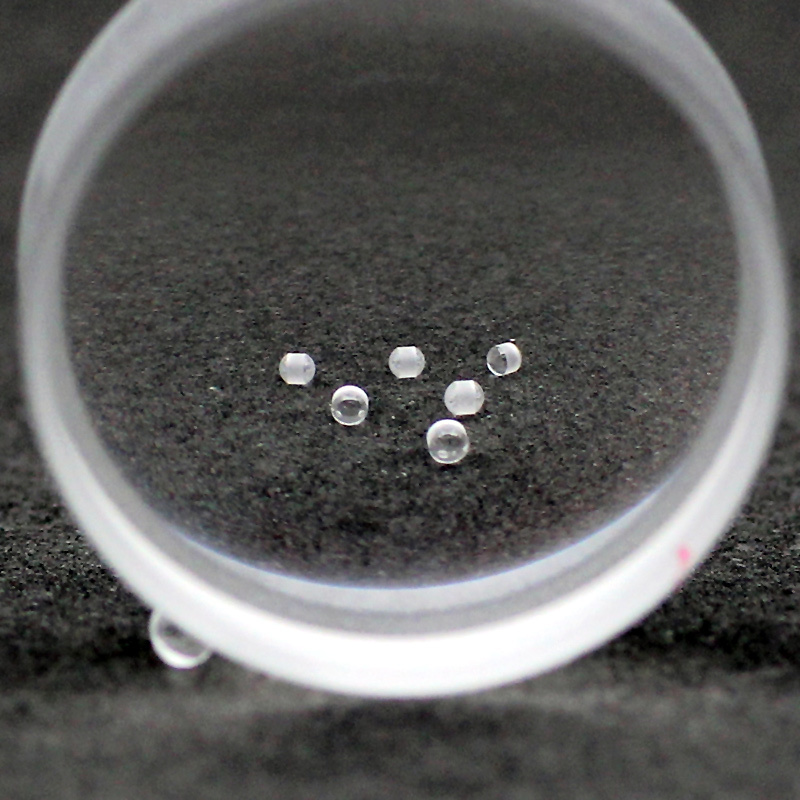
Double Convex Lenses, also referred to as Biconvex or DCX, feature positive focal lengths and two convex surfaces of equal radii. They are widely applied in image relay and close-conjugate imaging. As conjugate ratios increase, optical aberrations become more noticeable. DCX lenses suit a wide range of industrial fields and applications.

Parameters
Specification
Material
Optical Glasses, Fused Silica, Sapphire, Infrared Material, etc.
Diameter Range
0.5 ~ 600mm
Diameter Tolerance +0.00/-0.02mm Surface Irregularity λ/10@632.8nm Surface Quality 10-5 Focal Length Tolerance ±0.5% Centration 30 arc sec. Clear Aperture > 90% of diameter Bevel 0.2mm × 45° Coating As customer's request How Does a Double Convex Lens Work?
A double convex lens manipulates light mainly via refraction. When light enters the glass lens from air, it bends due to different refractive indices. Thanks to its double convex structure, incoming parallel light rays converge to a focal point. The distance from the lens to this point is the focal length, which is affected by surface curvature and material properties. Based on where the object is placed, this lens is able to form real or virtual images for different optical applications.
What imaging features does a double convex lens have?
A double convex lens is capable of producing real or virtual images, which hinges on how the object is positioned against the focal point. When the object lies outside the focal point, the resulting image is inverted and magnified. Meanwhile, objects placed within the focal range will form an upright and smaller image.
What are the common applications of double convex lenses?
Biconvex lenses are widely adopted in optical devices including cameras, microscopes, projectors and spectacles to focus light and enlarge images.
Double-Convex Lenses
Still deciding? Get samples first, Contact US !
Products Category
Tag list
Inquire Now
Note: Please leave your email address, our professionals will contact you as soon as possible!


Product Consulting
The company has been adhering to the enterprise tenet of people-oriented, honest management and customer first, providing customers with high-quality products and after-sales service.
Focus on us
Focus on us
Order Hotline
Telephone:+86 431 85660988
E-mail:
info@jtoptecs.com
Address:4655th FANRONG ROAD,HIGH-TECH AREA, CHANG CHUN, 130012,China


All rights reserved:Changchun Jiu Tian Optoelectric Co., Ltd.